How to write an executive CV
Aiming for an executive role? As you move up the career ladder, you need to prove to recruiters that you have the skills, experience and qualifications to deliver at the higher grades you’re aiming for. In this blog post, we’ll look into how to take your CV from entry-level to Board-level. Read on to develop an executive CV that fills you – and hiring managers – with confidence.
Main requirements of an executive CV
In line with all CVs, your executive CV should cover the following main categories:
- Header
- Profile
- Key Skills
- Professional Experience
- Qualifications and Professional Development
As an executive, you may have other sections to add, such as Awards, Publications, Keynotes, Community Leadership and Board Roles.
Step-by-step guide to writing an executive CV
Let’s look at those key sections in detail.
The header on an executive CV
It goes without saying that you need to include your name, email address and phone number here. As an executive, you probably also have a LinkedIn profile – add a link to the URL so that recruiters can check out your online presence easily. You should also add your location, in the form of town and postcode or, alternatively, you could state that you’re open to relocation.
The header is a great place to add an executive headline as well. In its simplest form, you can use your current or target job title or specify your industry. To take it up a notch, use this as an opportunity to very briefly state your USP, or Unique Selling Point. For example, “COO specialising in business turnaround” or “Technology Director with expertise in AI”.
Profile on an executive CV
The profile is your opportunity to sell yourself into the role. This is your elevator pitch, so there’s no room for waffle and padding – you have just 4 or 5 lines to convince the reader that your executive CV is worthy of consideration. State exactly what you do and reiterate any skills and experience you have that align with the job advert. You may also like to explain the value you can add to a business and what you can contribute. Avoid generic phrases and cliches here - focus on what you can offer that others can't.
Skills on an executive CV
As an executive, your CV needs to move past the generic “communication skills” and “works well in a team and independently”. At this stage of your career, it will be assumed that you have those most basic skills. Focus instead on higher level skills that hiring managers are looking for. Don't forget to highlight any skills you have that are specifically requested in the job advert.
In-demand skills on an executive CV include leadership, strategy development, change and transformation, cost saving, process improvement, business turnaround, revenue generation and so on. Any skills you claim to have in this section should be backed up by specific examples in your Professional Experience section.
In addition to these popular executive skills, there are some attributes that are viewed favourably at any stage of a career but which are often forgotten – things such as digital literacy, cultural awareness, diversity and inclusion, commercial acumen, mentoring and environmental awareness.
Professional experience on an executive CV
As with CVs at any level, this section should be laid out in reverse-chronological order. For every role you’ve held, create a sub-heading stating your job title, employer name, dates of employment and, if you’ve had an international career, the country you were based in.
Summarise the remit of each role in a few brief sentences and then add bullet points to show off your achievements in each position. It’s especially important to include quantifiable achievements on an executive CV, as hiring managers will need to know how you can have an impact. The value you’ve delivered before can be a good indicator of the value you’re likely to deliver in the future, and it provides credible proof of your ability.
Remember there’s no need to exhaustively list everything you’ve done in every role. Include only the information relevant to the position you’re applying for and remember that detail can be added at interview stage. Similarly, roles held over 10 years ago can be summarised in a line or two.
Example achievements for an executive CV
If you're struggling to write concise achievements that show off your impact, take inspiration from these:
- Secured savings of over €500,000 by establishing a digital marketing centre of expertise in Belgium
- Managed the business through 2 sets of industrial action and negotiated 4 pay deals with unions
- Led global matrix teams of SMEs to fine tune and implement new processes, balancing the different cultures, priorities and regulatory requirements of multiple countries
- Secured 5 rounds of funding, totalling £1.2million, enabling expansion and acquisition of new sites
- Brought together businesses, key industry partners and academics to develop public policy programmes and build collaborative partnerships that had never previously existed
Qualifications on an executive CV
Once you hit executive level, qualifications become less important and should be demoted to the bottom of your CV. O-levels, GCSEs and A-levels can be removed entirely. Degrees should always be included, along with the subject and awarding institution, and MBAs are often viewed positively in executive applications.
Professional Development on an executive CV
Here, you can list any relevant courses and certificates you’ve completed. Remember that the key word here is “relevant”. Courses completed over 10 years ago can be removed unless they’re particularly well-recognised or in demand, as can courses that have no bearing on your ability to do the role – such as qualifying as a scuba instructor when you’re applying for roles in logistics. Leadership development courses and industry accreditations, on the other hand, are valuable and should certainly be added.
The Professional Development section can be merged with the Qualifications section, if either is looking a bit light.ed
How to level up your executive CV
Now you have your basic executive CV completed, how can you take it to the next level?
The best way to make your CV stand out is to add some quantifiable results for every role you’ve held in the last 10 years or so. Consider whether you can quantify any strong outcomes you’ve delivered, such as KPIs, targets, costs, profits, time savings, projects and transformations. If your memory needs nudging, rummage back through your performance appraisals.
Awards are a great way to add credibility to your executive CV, as they show that someone else values your work. It doesn’t matter if they’re individual or team awards, or internal or external awards - the simple fact that you were recognised enables you to show your value on your CV.
Have you delivered any keynote speeches or presentations, or had an article or book published? Thought leadership is a valued attribute at the moment, so make sure your CV shows this off.
Don’t forget to add any additional credentials too – this could be membership or fellowship of an industry body, accreditations or licences.
What you’ve done outside of work matters too! Depending on how much space you have free, you can highlight additional skills by including external Board memberships or voluntary roles that show the higher-level skills that recruiters are looking for.
What NOT to do on an executive CV
Now you know what to include, let’s look at what an executive CV should never include:
- Photo: Anti-discrimination legislation means that your looks should never be taken into account during the recruitment and selection process. If you choose to include a photo for any reason, you could be inviting discrimination.
- References: If references are required, you’ll be asked for them further along in the hiring process. There’s no need to waste valuable space on your CV by adding details that aren’t required at this early stage.
- Outdated information: Focus on the last 10 years, then summarise or delete anything else. Recruiters are interested in what you can do now, not what you could do 25 years ago (can you even remember yourself what you were doing then?!).
- Potentially discriminating information: That includes date of birth, nationality, citizenship and family. They don’t affect your ability to do a job. Think of your CV as your personal marketing tool and only include information that sells you into the position. UK recruiters should really ignore this information anyway.
- Too much detail: Aim for two pages but if, after ruthless editing, you find you need three, go for it. One of the main challenges of an executive CV is condensing a long career into a short space but, by keeping the CV recent and relevant, two or three pages is definitely feasible.
- Cliches: Leave the “hardworking” and “enthusiastic” cliches for the school leavers. By the time you’ve worked your way up to executive level, you should have something more interesting and engaging to say about your career and your approach.
- Graphics and images: You may have seen online templates using graphics, images, skills bars, icons and logos – but such CVs rarely perform well. Stick to text-only, single-column formats with a standard font.
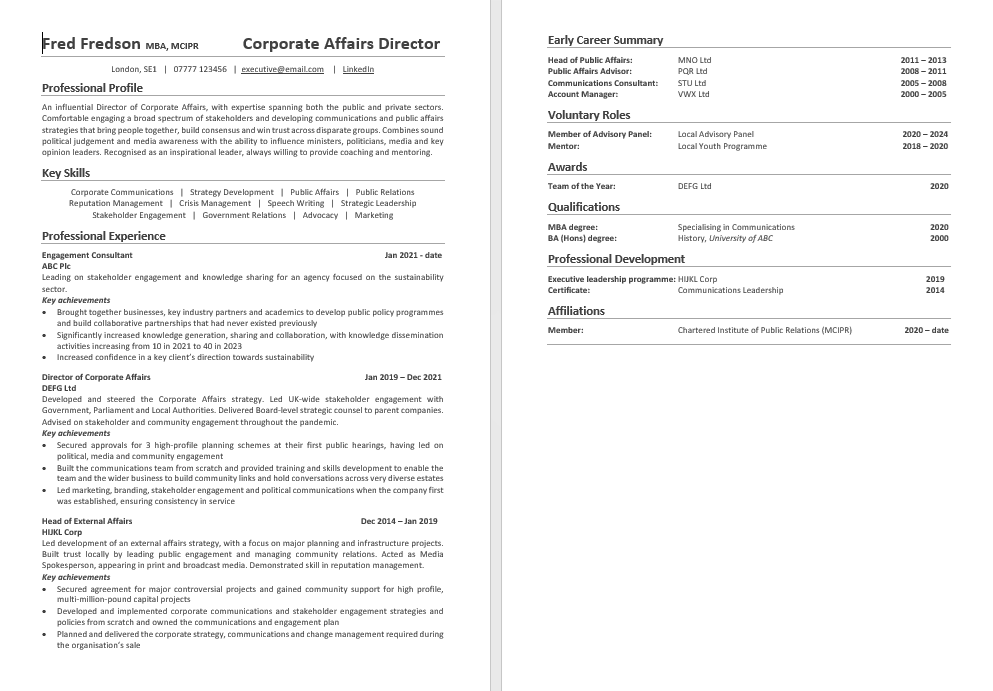
Executive CV example
Wondering how all that advice fits together to create a winning executive CV? Wonder no more. Take a look at this example that you can use as inspiration for your own executive CV template.
Step confidently into an executive role
Now you’ve fine-tuned your executive CV, you’re ready to start applying for your next position and develop your career even further. If you’re still unsure whether your CV hits the mark, if you need further guidance, or even if you just want an executive CV writer to take the whole job off your hands, help isn’t far away.
Take a look at Word Dragon’s services to see what further help is available. You'll be on your way to the C-suite in no time with a professional CV as part of your job search toolkit. Get in touch with a certified UK CV writer to find out more!
Updated 2026

Author bio: Jen is a UK-based careers writer with over 15 years' experience in writing CVs for UK professionals. She is a certified member of the British Association of CV Writers, with a Master's degree in English, and has written and edited articles for international businesses.
Share this Blog
More from my Blog..