
CV numbers: why you need them and how to use them
I admit it – I’m a word person. Words give you the means to express any concept you could dream of and transport your mind to marvellous places. Numbers just sit there glaring at you, being defiantly inflexible and stubbornly right or wrong.
Equally, I have to admit that a good CV needs numbers. Even for those who aren’t in mathematical or financial fields, CV numbers are a necessity. In some ways, they can add more value than the words! Adding numbers to your CV enables you to upgrade your CV from telling your story to selling your story.
Why should I use numbers in my CV?
A recruiter needs to understand exactly what you’ve done, what you’re capable of and where you can benefit an organisation. Using numbers on your CV enables you to back up and quantify statements which may otherwise be too generic or vague. Consider the impact of “managing budgets” against “managing budgets of up to £25million”.
CV numbers can also help a recruiter to understand how you’ve progressed in your career so far – for example, from managing two staff in one department to managing 50 staff in five departments.
What CV numbers should I include?
The data you quantify on your CV really depends on your role, but the most common (and necessary) figures include:
- The number of people you managed
- Your budget
- The outcomes you've delivered
Other figures - such as the number of accounts you manage, the number of sites you work across and the number of projects you’ve completed - may all be relevant depending on your role. The possibilities are endless! Identify the key figures which impact the scope of your role and ensure that they’re included.
As well as helping to describe your responsibilities, numbers can also bring credibility to your achievements. Anyone can claim to have reduced costs, for example, but if you can put a figure to this saving then you’re making it more believable and proving that you can deliver what you claim. Aim to add quantifiable achievements to every role you’ve held in the last 10 years.
Other vital CV numbers are your phone number (obviously – but having written CVs for over 15 years I've seen many CVs with no contact details!), dates (of employment, qualifications and courses) and grades (if they’re strong and very recent).
What numbers should I not include?
There’s one number that never has a place on a CV and that’s your salary. Past or present, never disclose this on your CV. You’re limiting your scope for negotiation and it may be detrimental to your candidacy if the recruiter thinks you’re over- or under-valuing yourself.
You also need to be careful not to disclose any commercially sensitive information. At best, it makes you look indiscreet and at worst it could land you in hot water with your current employer.
You should also carefully consider which dates you’re including – anything too far back and you may be leaving yourself open to age discrimination (yes, it’s illegal, but that’s not to say it doesn’t happen).
How to include CV numbers
Personally, I prefer to write CV numbers as digits, rather than words. It’s not conventional English, but it’s so much easier to notice and pick out numbers in a sea of words when they’re written as digits.
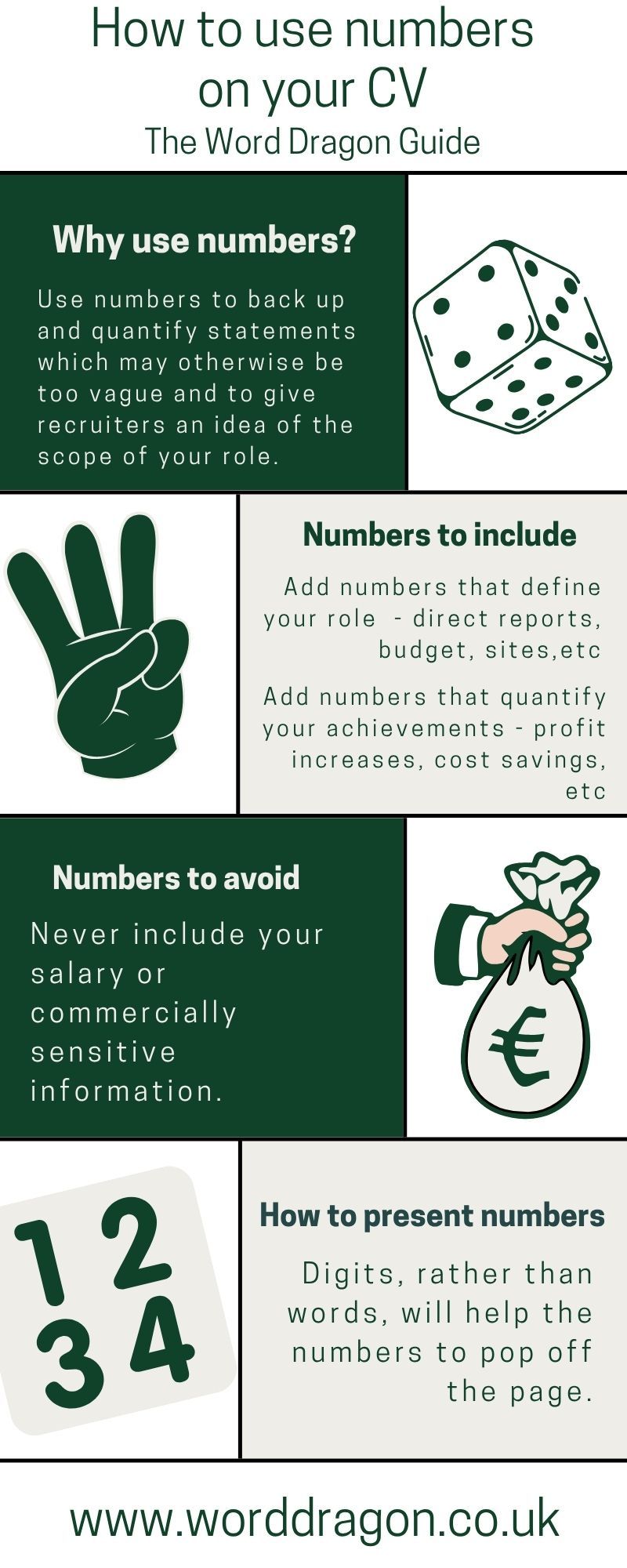
This infographic summarises the advice:
FAQs about CV numbers
Should I include page numbers on a CV?
Page numbers aren't really necessary any more, as CVs are often viewed on a screen and scanned into a database. That said, there's no harm including page numbers on a CV, especially if you think the CV may be printed out.
Should I spell out numbers on a CV?
Conventional English says that numbers below 10 are spelt out with letters, and numbers over 10 are written as digits. HOWEVER! On a CV it's OK to break the rules. Numbers add credibility and impact to your CV and writing all numbers as digits - whether above or below 10 - so that they pop off the page.
What is the most important number for a CV?
Without a phone number you're making it hard for a recruiter or hiring manager to contact you, so this is one number that you should never leave off your CV. It's also important to quantify the scope of your role and your achievements.
Need help putting numbers on your CV?
To present the strongest application possible, revisit your CV and identify where you could include numbers. It may help to review your original job description, if you still have it, or to compare your role with others with a similar job title. If you need more help writing your CV in the most compelling way, why not see how Word Dragon can help?
Updated 2026

Author bio: Jen is a UK-based careers writer with over 15 years' experience in writing CVs for UK professionals. She is a certified member of the British Association of CV Writers, with a Master's degree in English, and has written and edited articles for international businesses.
Share this Blog
More from my Blog..