
How to write a CV: The ultimate guide for UK professionals in 2026
A good CV requires strong wording, an easily readable layout, and clear headings. It's more than a dry list of facts; it's your personal sales pitch and needs to show exactly how you can contribute to a business.
This guide explains how to write a CV for professionals in the UK, with expertise drawn from over 15 years’ experience as a CV writer and up-to-date insight into current hiring practices and the UK job market.
What is a CV?
CV is short for Curriculum Vitae, which in turn is Latin for “course of life”. A CV is simply a summary of your work experience, key skills and qualifications, that is used during a job hunt to provide information to recruiters.
Recruiters often ask for CVs when they have a role to fill. They’ll then evaluate the CVs they receive to decide which applicants best meet their requirements. The strongest applicants will progress to interview stage, where their suitability for the role can be assessed further. A good CV explains to a recruiter why they should hire you and persuades them to invite you to an interview, so it needs to show explicitly why you’re the right person for the job.
Expert insight: The best CVs not only land you interviews, they also boost your confidence!
What are the features of a good CV?
While every CV is different, the best ones have some key qualities that make them stand out:
- Key sections: To ensure you have the necessary information in a logical structure
- Clear layout: To guide the recruiter to the information they want to see
- Focused wording: To enable the recruiter to see you meet their requirements
- Alignment with the job advert: To position you as the perfect match for the role
- Specific achievements: To prove you can add value to a business
How to structure a CV in the UK
If you're writing a CV for the UK market, you'll need the following section headings:
- Name and contact details
- Professional profile
- Key skills
- Professional Experience
- Qualifications
- Further details
Start your CV by putting each of these sections on the page as a heading. We’ll look into what to put in each section below.
What to include in a UK CV
Your CV should include all the information a recruiter needs to decide whether to invite you to an interview... and nothing else. If you find yourself adding detail that isn’t directly relevant to your target role, remove it – there’s no space for waffle and fluff on a CV. Everything you include should be focused on your next steps. If you're not sure what to include in your CV, you can get help from a professional CV writing service.
Name and contact details
Without any contact details, a CV is useless. Include your phone number and email address alongside or below your name. Ideally you'll include your location, too. A full address is no longer necessary - who sends letters these days?! You may also like to consider a link to your LinkedIn profile or your online portfolio, if you have one. This section must be positioned right at the top – it’s where recruiters expect to find it, and your job is to make their job easy.
Example:
Joe Bloggs * London, SW19 * 07777 123456 * joe@bloggs.co.uk * LinkedIn
You may have noticed there's no date of birth in the example - that's no longer required (although it used to be commonplace), mainly due to anti-discrimination legislation. You may like to consider a link to digital media instead, to show off your work.
Headline
Optional, but nice to have on your CV, is a headline. This can be as simple as a job title or as detailed as a whole sentence - but no more. Position it either next to or underneath your name. The headline should show the reader at a glance that you are well suited to the open vacancy; this could be in terms of job title, industry experience, key skill or specialist knowledge.
Professional profile
The CV profile is equivalent to your elevator pitch. Write four to five lines summarising who you are, what you do and how you add value to a business. Consider including your job title, industry, seniority, unique selling point, key successes, drivers and so on. Your aim with this section is to make a great first impression and convince the recruiter to read the rest of the CV.
Example:
A commercially astute Change Manager, with expertise in strategy delivery and culture change across the EMEA region. Able to develop and implement plans aligned with global strategies and identify regional priorities. Manages budgets of up to £10million and multidisciplinary teams across 5 countries. Confident coaching and mentoring senior business leaders and recognised as an empowering leader.
Key skills
The aim of the key skills section is to differentiate you from the other applicants by providing an at-a-glance summary showing that you have the skills needed to excel in the vacant position. Use keywords based on hard skills and align them with the requirements of the job advert.
Aim for between six and twelve skills and ensure you provide evidence of each skill in the Professional Experience section. Try to avoid soft skills here – anyone can claim to be able to communicate or work as part of a team. Think instead about terms that a recruiter might use when they’re searching their CV database. No-one ever searched for “enthusiastic” – they’re much more likely to search for words related to the specific role they’re trying to fill.
Example:
Legal Research * Legal Administration * Client Confidentiality * Relationship Management
Process Improvement * Programme Coordination * Document Proofing * Briefing
Professional Experience
Present your professional experience on your CV in reverse-chronological order. Include your job title, employer name, dates of employment, key remit and a summary of your achievements for each role. Respect the recruiter’s time by being concise and to the point.
Having seen thousands of CVs here at Word Dragon, I recommend writing three or four lines about the remit of the role, followed by a bulleted list of five or six achievements. This format works as it forces concise writing, focuses on the most important points, and draws attention to how you’ve added value to a business.
Don’t be tempted to skip the achievements, even if you think there’s nothing to write. Everyone has achieved something! The best achievements are quantifiable, such as “Won 10 new clients by understanding their pain points and recommending solutions”, but even unquantifiable achievements like “Improved team morale by organising celebrations and team days” are better than no achievements at all.
Example:
Spearheading employee relations across multiple disciplines, encompassing grievances, disciplinaries, redundancies and annual salary reviews, as well as providing generalist HR advice. Advising managers on performance issues and coaching them through workforce reductions. Developing HR policies and ensuring consistent implementation.
Key achievements
- Saved £140,000 in agency fees by leading a recruitment campaign for Engineers in India
- Reduced errors by 75% by introducing process checklists for key HR processes
- Recruited 30 new UK staff in just one month
- Coached 2 staff into more senior roles
- Deputised for the Head of Department during an extended absence
Qualifications
The qualifications section should be presented in reverse chronological order just like your experience. List the level of your qualification, the subject and the year. University-level qualifications should include the name of the university, as well. Recent graduates might also like to include key modules and the titles of projects, theses or dissertations. Those with a more extensive work history only need to include their highest-level qualification, but may have training courses and certificates to include as well.
Qualifications and training can be separated into two different sections or combined into one, depending on the relevance and number of each and the space available on the CV. Decide which will work best for you personally.
Example:
BA (Hons) degree: English and American Literature, University of East Anglia, 2000
Certificate: Lean Six Sigma Yellow Belt
Further details
This section can be used for any information that doesn’t directly link to any of the sections above – consider languages, volunteering, hobbies and anything else that may set you apart from other candidates.
This section should not contain information critical to the role you’re applying for – think of it as the icing on the cake, rather than the cake itself.
Example:
Interests: Investing in shares and funds, keeping fit at the gym and playing drums
Languages: Fluent English and Turkish
It used to be common to end the CV with "References available on request", or even contact details for your referees, but
references are no longer expected.
Choosing the wording for your CV
The right words can transform a good CV into a great CV. To maintain a recruiter's interest, choose your words carefully and write with your reader in mind.
Reflect the advert
Analyse some adverts for roles you’re interested in and note any words that keep popping up. Those are the ones you need to include – for example, if the advert is looking for someone with experience in managing budgets, make sure your CV states that you can manage budgets. Recruiters aren’t mind readers - if it’s not on your CV they won’t give you the benefit of the doubt when they have a huge pile of CVs to look at.
Use dynamic vocabulary
Choose your wording carefully to make your CV sound more interesting and credible. For example, instead of saying you were “responsible for customer service”, say you “delivered great customer service”. Instead of saying you “helped with sales”, say you “maximised sales”, or “drove sales” or “achieved sales targets”.
Avoid repetition
Repetition makes for a pretty boring CV. It wastes your time writing it and a recruiter’s time reading it. Don’t just say you were “managing this, managing that and managing the other”. Choose more interesting ways of sharing your responsibilities - for example “led this, directed that and oversaw the other”.
Write without pronouns
It may seem a bit unnatural, but CVs are conventionally written without pronouns. That means removing the “I”, “my” and “me” wording. Rather than saying “I sell cars”, just write “selling cars”.
Writing a CV: top tips
- Stay truthful and honest
- Avoid jargon and acronyms
- Focus on how you add value to a business
- Show how you meet the requirements of the role
Expert tip: Show your CV to someone who doesn’t know what your job involves – if they can’t explain what you do after reading it, it’s time for a rethink!
UK-specific CV guidance
Much online CV advice originates in the US, but UK CVs are not the same as CVs in other countries - even though their purpose is the same. The key differences are:
- UK CVs do not include photos or personal details such as age, nationality, marital status or passport number
- UK CVs tend to be a maximum of two pages long (more on this below!)
- UK CVs are tailored to specific roles (or at least a specific type of role)
And of course, we use British English, not American English. Make sure you set your spell-check to the right language to avoid errors creeping in. Working with a professional CV writer will help to ensure your CV is appropriate for the UK job market.
CV formatting best practice
Every recruiter will have their own idea about what constitutes the ideal layout for a good CV. What one loves another may hate, so there's no one-size-fits-all and you can put your own stamp on it.
Most open vacancies these days attract tens, if not hundreds, of applications, meaning that recruiters only spend a few seconds on the initial scan of each CV. Therefore, they need to be able to pick out the information they’re looking for quickly. Your format should prioritise readability and scan-ability, as you only have moments to grab attention.
Keep critical information in the top half of the first page
That’s what the recruiter sees first and that’s what will make that all-important first impression. If it’s not recent or impressive, it doesn’t need to be taking up prime real estate. Newspapers always put their headline news "above the fold" - the same principle applies to your CV. Major achievements, your current job and your unique selling point should all be in the top half of the first page. Something you did 20 years ago should not.
Prioritise information
If your education is more recent or impressive than your career, put that section above the Professional Experience section. If your technical skills are more important in your target role than your current job, put those first. If something is outdated or irrelevant, leave it off altogether.
Keep it simple
A CV that’s easy to read makes life easier for the recruiter. Structure the CV clearly and don’t cram information in – a solid wall of text is very off-putting. Bullet points and short paragraphs are the preferred layout choice, as they're easy to skim and encourage brevity. HR systems also parse CVs better when there are no graphics, text boxes, logos or photos.
How long should a UK CV be?
As a rule, a CV in the UK is two pages long… but the truth is, there’s no one-size-fits-all answer for the length of a CV. Generally, one to three pages is what you should aim for, but a lot depends on how your career has progressed so far.
Entry level
One page is generally enough for your first step on the career ladder. You only need to outline your education and skills, although if you have any experience from weekend jobs, pocket-money work or volunteering, you'll be able to fit that on too.
Mid career
Two pages is often hailed as the perfect CV length and when you're established in your career it's probably what you should be aiming for. However, don't drag out to two pages what could easily fit on one, just for the sake of having a CV the "right" length. The content of a CV, and therefore how long your CV is, depends on your personal experience.
Executive
If you can fit your CV on two pages, do - it's still the ideal to aim for. If it feels like two pages is selling you short, by all means extend it to three - but make sure every word counts.
Exceptions to this rule are doctors and academics, who can use several more pages to accommodate their research, publications and teaching.
How far back should a CV go?
Ten years is the ideal span of a CV. The Professional Experience section should cover every role you’ve held in the last decade or so. Earlier roles can simply be summarised with the job title, employer name and dates, so that recruiters can see your career progression. Any roles held before the millennium can be removed, if they add no value.
Expert tip: If you’re worried about age discrimination, you can remove the dates in the early career summary.
ATS – separating fact from fiction
Unscrupulous CV writers trying to sell their service have given ATSs an unfair reputation. If you’re not sure what an ATS is, it’s an Applicant Tracking System – a system used by recruiters to manage vacancies and applications. You can find out more about ATS in this post, but the short version is that a well-written CV, in a sensible format, will not cause you any problems.
Common mistakes when writing a UK CV
With over 15 years’ experience reviewing and writing CVs, Word Dragon sees the same mistakes crop up all the time. If you want to make the right first impression on recruiters and hiring managers, make sure you’re not making these common CV mistakes.
1. Not including achievements
2. Not adding metrics
3. Not tailoring the CV to the target role
4. Using clichés
5. Not explaining career breaks
CVs often dilute great information with
detail that just doesn't need to be there. Make sure your CV is focused on your reader and the role you're aiming for, so that you
get noticed when you apply.
Common CV problems
Not every career fits into a nicely defined box, so what should you do if standard CV advice doesn’t apply to you? Let’s take a look at some common issues.
Age discrimination
To avoid age discrimination in the initial stages of the job search, minimise age indicators on your CV. For example:
- Remove dates over 20 years ago
- Remove CSEs and O-levels
- Don’t specify how much experience you have (for example, say 20+ years, rather than 42 years)
- Include modern technology and tools you’re confident using
Too many jobs to fit on the CV
Job-hopping, short-term contracts and temporary roles can be a challenge when you’re trying to summarise your entire career. Use these techniques to minimise the impact:
- Only go into detail for the last 10 years (or 5, if you’ve held a lot of jobs)
- Remove detail and only give a top-level overview
- Eliminate roles that don’t add value, if you can do so without leaving a gap
- Merge similar short-term roles under one heading
- Summarise less relevant jobs in a line or two
Career gaps
Career gaps and redundancies are a perfectly normal part of life – it’s how you frame them on the CV that matters. Don’t gloss over them and hope no-one notices. Use the header Career Break and the relevant dates, followed by a very brief explanation. For example:
- Sabbatical to travel across Asia
- Raising a family and completing DIY projects
- Studying towards a qualification in Data Engineering
Aiming for a career change
Career changes can require a completely different approach to your CV, as much of your previous experience won’t be relevant. In that case, try:
- Adopting a skills-based approach, giving examples of when you’ve used the key skills needed in your target role
- Minimise detail relating to previous roles
- Move the Qualifications section higher up the CV if you have undertaken relevant study
- Add a cover letter to convey your intentions and aspirations
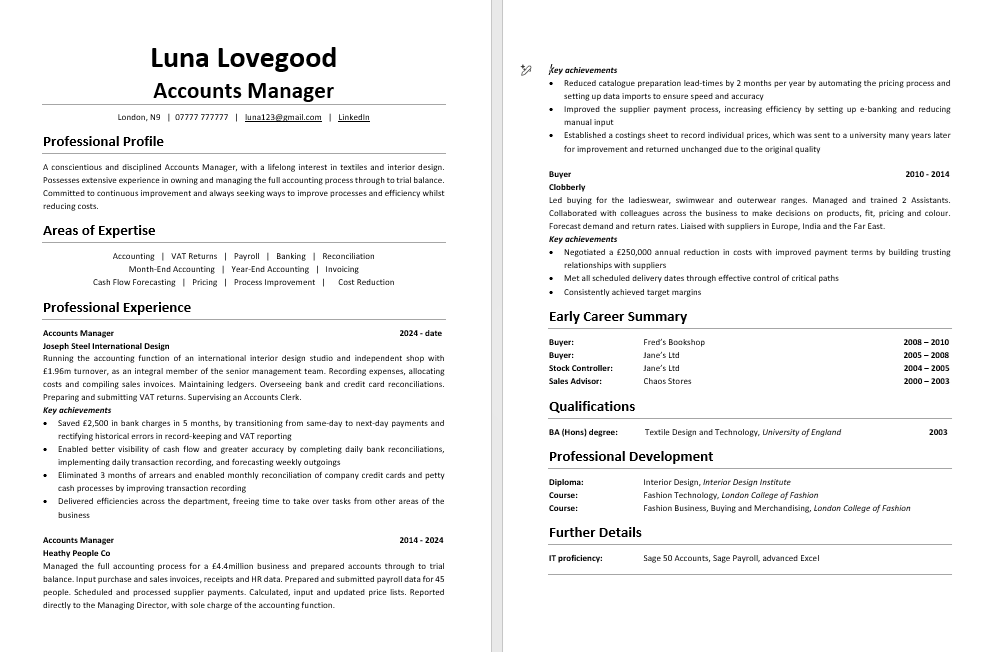
Example of a CV for a UK professional
Let’s put the theory into practice. Take a look at this example CV – but remember that yours should be personal to you and there’s no single correct way of writing a CV.
UK CV FAQs
Fancy a quick-fire round? These are the most common questions about writing a CV.
How long should my CV be?
Your CV should probably two pages, but one or three can work too. The right length depends on what you've done in your career.
How far back should my CV go?
Your CV should go back for 10 years in detail, give or take. Find out more about how far back to go here.
What skills should I put on my CV?
A mix of hard and soft skills is needed on your CV, which should reflect the requirements of the job advert.
What are the best keywords for my CV?
The best CV keywords reflect the specific requirements of the job you're applying for.
How do I tailor my CV to a job?
To tailor a CV to show a recruiter that you're the best person for the job, you need to clearly show in every section how you meet the requirements of the role. Refer to the job advert as you write your CV to ensure you cover al bases.
Can I use colours on my CV?
Why not use a splash of colour on your CV? It needs visual appeal but remember it’s not an art project! Find out more about presentation here!
Should I hide keywords in white text?
Hiding keywords in white text on a CV is one of those CV myths that just won't die. It's a terrible idea that you should avoid at all costs.
Can I lie on my CV?
You should never lie on your CV. The good news is that you don’t need to – you’ll sound great anyway if you follow the advice from Word Dragon!
UK CV template download
It can be tricky to know where to start when it comes to writing a CV. Why not make the process a bit easier by downloading this free template, designed especially for UK professionals by a certified CV writer?
The golden rule for writing a professional CV
Every part of the CV needs to sell you. If the words don't sell you, re-write them. If the layout doesn't sell you, rework it. Your ultimate aim is to shine a spotlight on your experience, skills and qualifications, leaving the reader in no doubt that you're the right person to fill their vacancy.
Expert CV help
If this all seems like a lot of bother, why not get Word Dragon on side? With services ranging from an evaluation of your existing CV to a full CV from scratch, you’ll be able to step into your job search with confidence, knowing that your CV is presenting you to recruiters as an experienced, qualified and capable professional. Find out more about CV writing services here or place an order!
Blog updated May 2026

Author bio: Jen is a UK-based careers writer with over 15 years' experience in writing CVs for UK professionals. She is a certified member of the British Association of CV Writers, with a Master's degree in English, and has written and edited articles for international businesses.
Share this Blog
More from my Blog..